
Fulton Sheen Beatified: How the TV Bishop Became Blessed
Archbishop Fulton J. Sheen, one of the most recognizable Catholic communicators of the 20th century, has been beatified in St. Louis, marking a major step in a sainthood cause that has unfolded over more than two decades.
The beatification took place on September 24, 2026, at The Dome at America’s Center, where Cardinal Luis Antonio Tagle represented Pope Leo XIV and presided over the celebration. The Diocese of Peoria confirmed afterward that Sheen is now formally known as Blessed Fulton J. Sheen.
Just one day before the Mass, Pope Leo XIV used his General Audience in St. Peter’s Square to highlight Sheen’s unusual legacy. The Pope focused especially on his ability to bring Christian teaching into American homes through radio and television, decades before digital evangelization became part of everyday Church life.
It was a fitting tribute to a bishop whose ministry was built around a simple but surprisingly modern idea: if people were spending their time listening to radio and watching television, the Church should be willing to meet them there.
Pope Leo XIV Praised Sheen Before the Beatification
Speaking ahead of the ceremony, Pope Leo XIV described Sheen as a bishop known for evangelizing through the media and expressed hope that his example would encourage others to discover new ways of sharing the Gospel.
The Pope’s comments carried an interesting personal connection as well. Earlier in 2026, Leo had recalled seeing Sheen’s television ministry while growing up in the United States and described himself as a witness to the impact of that work.
That connection makes Sheen’s beatification especially notable.
He was not simply a historical religious figure being remembered decades after his death. His broadcasts were part of the culture in which many American Catholics, including the future Pope, grew up.
Long before sermons could spread through social media clips, podcasts or streaming platforms, Sheen understood that television could carry religious ideas to people who might never enter a church to hear them.
Pope Leo’s message also looked beyond nostalgia. His emphasis was on Sheen as an example for today, particularly for people trying to communicate faith through changing forms of media.
Fulton Sheen Is Now Officially Blessed
The September 24 ceremony changed Sheen’s formal title within the Catholic Church.
Before the Mass, he was known as Venerable Fulton J. Sheen. Following the beatification, he became Blessed Fulton J. Sheen.
Cardinal Luis Antonio Tagle, Pro-Prefect of the Dicastery for Evangelization, presided over the Mass as Pope Leo XIV’s representative.
During his homily, Cardinal Tagle focused on Sheen’s missionary identity rather than simply his television fame. He described the newly beatified bishop as a preacher who used modern communications effectively but stressed that popularity itself was not what made Sheen’s life spiritually important.
Tagle pointed instead to Sheen’s relationship with Christ and his commitment to bringing the Gospel to others, particularly people who were poor or vulnerable.
That distinction matters when looking back at Sheen’s career.
He was unusually famous for a Catholic clergyman, appearing on television during an era when a small number of networks dominated American entertainment. But within the Church’s understanding of his life, celebrity is not the reason he has advanced toward sainthood.
His media presence was a tool. His religious mission was the point.
Thousands Traveled to St. Louis
Interest in the beatification was enormous even before the event began.
Organizers had expected nearly 45,000 pilgrims from 48 American states and 12 countries. More than 80 bishops and hundreds of priests were also expected to participate. The official event organizers reported before the celebration that 83 bishops and more than 870 priests had registered.
The scale reflected the unusual reach of Sheen’s legacy.
Although his strongest public recognition came during the middle of the 20th century, recordings of his talks continue to circulate online. Younger audiences who were born decades after his death can now find the same sermons and television appearances through digital platforms.
In a strange way, the technology has changed while Sheen’s method has survived.
He once entered homes through a television set. Today, the same material can appear on a phone screen.
The St. Louis celebration included far more than the beatification Mass itself. The schedule featured prayer, confession, talks, music, exhibits and opportunities for veneration of Sheen’s relics after the ceremony.
How Fulton Sheen Became a Television Star
Fulton John Sheen was born on May 8, 1895, in El Paso, Illinois.
He was ordained a priest in 1919 and continued his studies in the United States and Europe, including at the Catholic University of America in Washington and the Catholic University of Leuven in Belgium. His academic background eventually helped shape the clear, structured style that became one of his trademarks as a public speaker.
Sheen began reaching a large national audience through radio well before television made him famous.
Starting in 1930, he appeared on The Catholic Hour, a Sunday radio broadcast that eventually reached millions of listeners.
Television took that reach to another level.
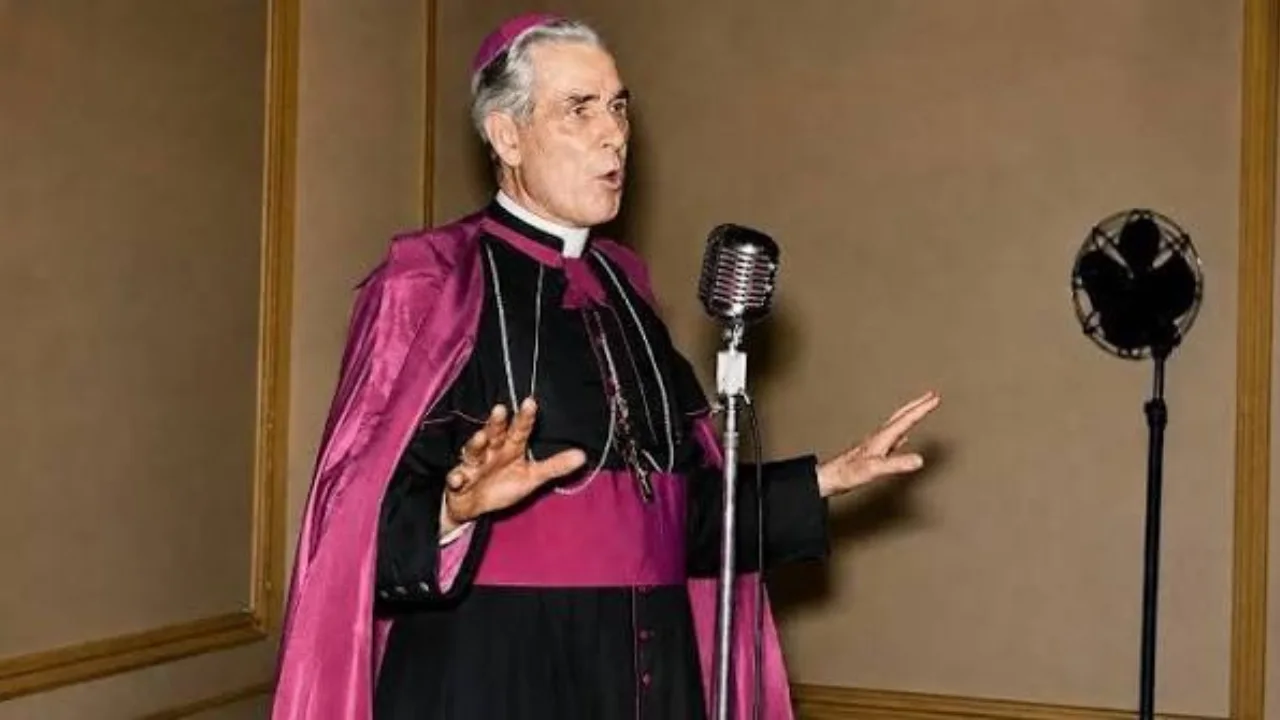
His program Life Is Worth Living became a major success during the 1950s. Sheen stood before a simple blackboard, usually wearing clerical clothing, and spoke directly to the camera about faith, morality, human behavior and everyday life.
There was no elaborate production.
Much of the attraction came from Sheen himself.
He could move between serious theology, humor and observations about ordinary life without sounding like he was reading from an academic lecture.
Millions watched him.
At a time when television audiences were concentrated around relatively few channels, a Catholic bishop became a familiar figure in homes across the United States.
He Even Won an Emmy Award
Sheen’s success was not limited to religious circles.
In 1953, he received an Emmy Award for Most Outstanding Personality.
The achievement says something about how unusual his position in American culture had become.
He was competing for attention in the same medium as professional entertainers and television personalities, yet audiences continued tuning in to watch him discuss religious ideas.
Sheen was known to use humor about the award as well, showing the kind of personality that helped make relatively serious topics accessible to a broad audience.
His communication style made him one of the earliest examples of a religious leader understanding television not simply as entertainment, but as a powerful communication system.
Today that idea seems ordinary. Churches livestream services. Priests, pastors and religious teachers run YouTube channels, podcasts and social accounts.
In Sheen’s era, it was far less obvious.
That is one reason Pope Leo XIV’s comments about finding new methods of evangelization fit Sheen’s story so naturally.
His Ministry Went Far Beyond Television
The television programs are what many people remember first, but Sheen’s life in the Church was much broader.
He was a theologian, professor, author, preacher and missionary advocate.
For years he taught at the Catholic University of America and developed a reputation as a gifted lecturer. He also maintained a strong connection to Catholic missionary work around the world.
His spiritual life was also central to how supporters of his sainthood cause understand him.
Sheen was particularly associated with the practice of spending a daily Holy Hour in prayer before the Eucharist.
That private discipline offers a different picture from the polished television personality remembered by the public.
Behind the cameras was a priest who believed his public work had to come from a regular life of prayer.
That theme appeared again during the beatification, where Cardinal Tagle cautioned against measuring evangelization simply through audience size or public reach.
In modern language, Sheen had impressive numbers. Millions of viewers, millions of radio listeners and enormous name recognition.
But the beatification ceremony deliberately placed the emphasis somewhere else.
Sheen Became Bishop of Rochester
Sheen also served in the leadership of the Catholic Church in the United States.
Pope Paul VI appointed him Bishop of Rochester, New York, in 1966. He stepped down from leadership of the diocese in 1969 but continued preaching, writing and carrying out public ministry afterward.
He was then given the title of Archbishop and remained a prominent Catholic voice during the final decade of his life.
His health weakened in later years, but he continued his religious work.
One particularly remembered moment came shortly before his death, when Pope John Paul II visited New York in 1979. According to the Sheen Foundation’s account, the Pope embraced him and praised the way he had spoken and written about Jesus Christ.
Sheen died on December 9, 1979, at the age of 84.
His death ended his active ministry, but not the reach of his recordings and writings.
The Long Road to Beatification
Sheen’s sainthood cause formally opened in the Diocese of Peoria in 2002.
In 2012, Pope Benedict XVI recognized his heroic virtues and declared him Venerable.
Another major step came in 2019 when Pope Francis authorized recognition of a miracle attributed to Sheen’s intercession.
The recognized case involved a child who was born without a heartbeat or respiration and later recovered after prayers seeking Sheen’s intercession. Vatican News reports that the child was revived after 61 minutes and recovered to good health.
Recognition of that miracle cleared the canonical requirement necessary for beatification.
The process still took years before a date for the ceremony was finalized.
In February 2026, the Diocese of Peoria announced that the Holy See had informed officials that the cause could proceed. The September ceremony was formally announced soon afterward.
The long-awaited moment finally arrived in St. Louis on September 24.
Why Fulton Sheen Still Feels Relevant
Sheen lived in a media world that now looks almost simple.
There was no social media, no streaming ecosystem and no endless feed competing for attention every few seconds.
Still, the basic challenge he faced remains familiar: how do you communicate something serious in a medium often built around entertainment?
Sheen’s answer was not to reject the technology.
He learned how to use it.
That may be the most obvious link between his career and Pope Leo XIV’s remarks before the beatification.
The Pope did not simply praise what Sheen had done in the past. He pointed toward the possibility that others could follow the same principle by discovering new ways to communicate faith with enthusiasm.
That could mean television, podcasts, social platforms or technologies that have not become mainstream yet.
The medium may keep changing.
Sheen’s example suggests that the more important question is what someone chooses to do with it.
What Comes After Beatification?
Beatification is a major milestone, but it is not the final stage in the Catholic Church’s sainthood process.
Sheen can now be publicly venerated as Blessed Fulton J. Sheen according to the norms established by the Church.
Canonization, which would formally recognize him as a saint of the universal Church, would require the cause to advance further.
The Diocese of Peoria made that hope clear after the ceremony, celebrating the beatification while looking toward the possibility of eventual canonization.
For now, however, the focus is on what happened in St. Louis.
A priest who began preaching over radio nearly a century ago, became one of America’s best-known television personalities and spent decades presenting Christianity through emerging media has now been declared Blessed.
For Pope Leo XIV, Fulton Sheen’s legacy is not only about remembering a successful communicator from another era. It is also about the idea behind his work: go where people are, understand how they communicate and find a way to speak to them there.