
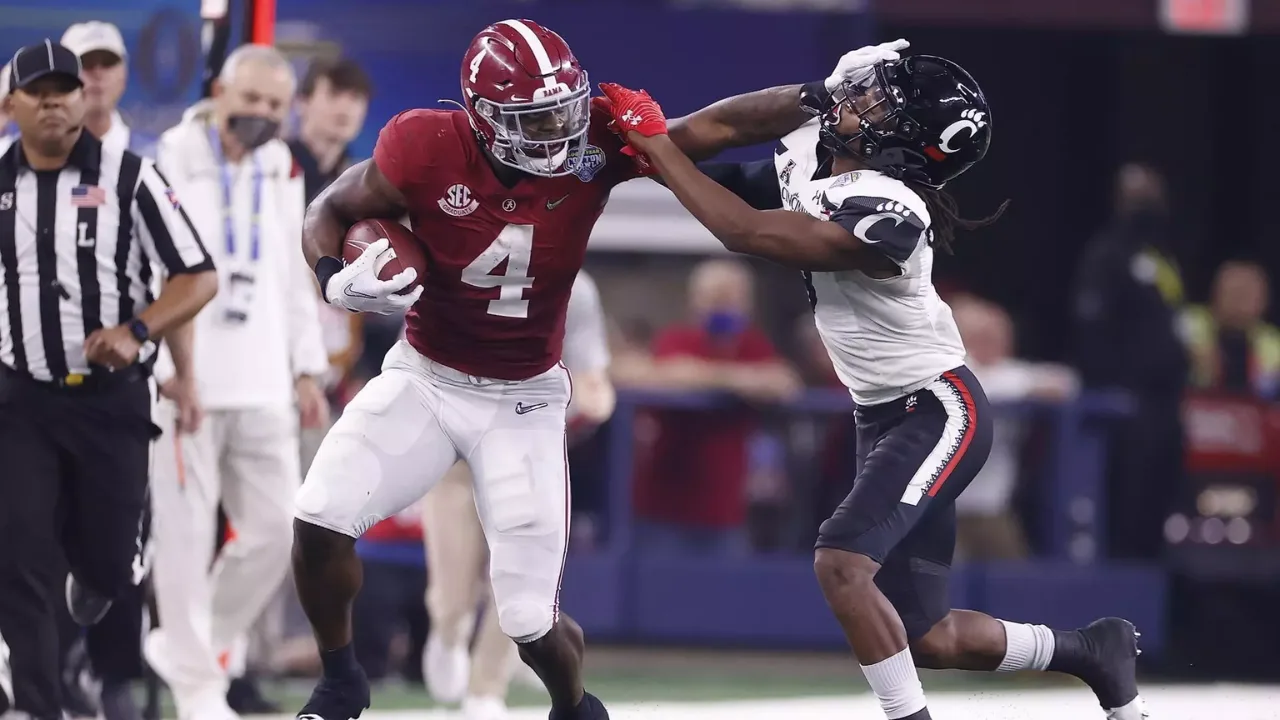
Brian Robinson Jr.: How He Became an Alabama Football Star
Brian Robinson Jr. did not arrive at Alabama and immediately become the face of the Crimson Tide backfield. His college story was different. It was built around patience, competition and the willingness to keep working while other talented running backs received bigger roles.
By the time Robinson finally became Alabama’s starting running back in his final season, he was ready for it. He responded with the best year of his college career, producing more than 1,300 rushing yards, leading Southeastern Conference running backs in rushing touchdowns and delivering several of the biggest performances of Alabama’s season.
His path stands out because it was not built on instant success. Robinson spent years waiting behind other highly regarded players before earning the chance to lead the offense himself. When that opportunity eventually came, he turned it into a season filled with awards, career highs and memorable postseason moments.
Brian Robinson Jr. Had to Wait for the Starting Job
College football is full of players who transfer when early playing time becomes difficult to find. Robinson took another path.
At Alabama, he entered one of the deepest running back rooms in the country. Competition for carries was constant, and becoming the featured back was never guaranteed.
Instead of leaving, Robinson stayed with the program and continued developing.
That patience finally paid off during his final season. He became Alabama’s primary running back and handled a workload unlike anything he had experienced earlier in his college career.
Robinson finished his Alabama career with 2,704 rushing yards. That total placed him 11th in program history at the end of his college career.
He was also tied for 10th in Alabama history with 29 career rushing touchdowns.
Those numbers are impressive on their own, but they become more meaningful considering how long Robinson spent sharing carries and waiting for a larger role.
His final year showed what he could produce when Alabama finally placed the offense on his shoulders.
His Final Alabama Season Changed Everything
Robinson entered his last college season with high expectations.
He had already gained experience in Alabama’s offense, but this time he was no longer simply a rotational running back. The starting role belonged to him.
He quickly proved that Alabama could rely on him.
Robinson finished the season with 1,343 rushing yards on 271 carries. He also scored 14 rushing touchdowns, the highest total among SEC running backs.
His production was not limited to rushing.
Robinson caught 35 passes for 296 yards and added two receiving touchdowns. That gave him 16 total touchdowns for the season.
His 1,343 rushing yards ranked third in the SEC and 15th nationally, while his 16 total touchdowns placed him third in the conference and 20th nationally.
For a player who had spent several seasons waiting behind others, it was a huge transformation.
Robinson had gone from a supporting piece to one of the most productive offensive players in the conference.
His Ole Miss Performance Became a Career Moment
One game captured Robinson’s rise better than almost any other.
Against Ole Miss, he delivered one of the strongest performances of his Alabama career.
Robinson carried the ball 36 times for a career-high 171 rushing yards and four touchdowns.
The 36 rushing attempts were also a personal best.
Alabama repeatedly trusted Robinson to move the chains and finish drives. He converted eight first downs in addition to scoring four times.
His performance placed him in rare Alabama company. Robinson became one of only nine players in program history at the time to record at least four rushing touchdowns in a game.
It was the first such performance by an Alabama player since Trent Richardson achieved the feat in 2011.
The showing brought Robinson several honors.
He was named Walter Camp Offensive Player of the Week and Maxwell Award Player of the Week. He also earned SEC Offensive Player of the Week recognition and Reese’s Senior Bowl Offensive Player of the Week honors.
For Robinson, the Ole Miss game was more than another productive afternoon. It showed that he could be the centerpiece of Alabama’s offense against SEC competition.
Robinson Followed It With Another Big Game
Great running backs are often judged by whether they can repeat a dominant performance.
Robinson did exactly that one week later against Texas A&M.
He rushed for 147 yards on 24 carries and averaged 6.1 yards per attempt.
It marked his second consecutive 100-yard rushing performance.
Robinson also showed his versatility as a receiver. He caught four passes for 60 yards, giving Alabama an additional option out of the backfield.
Three of those receptions resulted in first downs.
The game reinforced one of the most important parts of Robinson’s development. He was no longer only a traditional downhill runner. Alabama could use him in the passing game as well.
That versatility helped him become a more complete offensive player during his final season.
Mississippi State Showed His Receiving Ability
Robinson continued his strong run against Mississippi State.
He carried the ball 11 times for 78 yards and two touchdowns, averaging more than seven yards per rush.
Yet his receiving production was just as impressive.
Robinson recorded a career-high five receptions for 68 yards and another touchdown.
One of those receptions went for 51 yards, the longest catch of his college career, and ended in the end zone.
The performance demonstrated how difficult Robinson could be to defend when Alabama found ways to involve him beyond basic rushing plays.
He could handle a large number of carries when necessary, but he also had enough receiving ability to create significant gains in space.
Tennessee Added Another Three-Touchdown Performance
Robinson continued to produce against Tennessee.
He ran 26 times for 107 yards, reaching the 100-yard mark for the third time that season.
He also scored three rushing touchdowns.
In addition, Robinson caught four passes for 16 yards.
At this stage of the season, his role in Alabama’s offense had become obvious. He was receiving major workloads against conference opponents while still contributing as a receiver.
Against LSU, his rushing production dropped significantly, but Robinson still found the end zone.
He finished with 18 rushing yards on 13 carries and scored one touchdown while adding an eight-yard reception.
Even during games when running space was difficult to find, Alabama continued trusting him in important situations.
His Longest College Touchdown Came Against New Mexico State
Robinson produced another efficient performance against New Mexico State.
He needed only nine rushing attempts to finish with 99 yards and two touchdowns.
The biggest moment came on a 63-yard touchdown run, the longest rushing score of his Alabama career.
He also caught five passes for 36 yards.
The game offered another example of Robinson’s ability to produce explosive plays while handling multiple responsibilities in Alabama’s offense.
A week later against Arkansas, he returned to the 100-yard mark.
Robinson rushed 27 times for 122 yards in his final appearance at Bryant-Denny Stadium.
He also caught three passes for 18 yards.
It was his fourth 100-yard rushing performance of the season and a fitting home finale for a player who had spent his entire college career waiting for the opportunity to become Alabama’s featured back.
Injury Tested Robinson Late in the Season
Robinson’s final season was not completely smooth.
During Alabama’s rivalry game against Auburn, he suffered a leg injury that limited his availability.
Before leaving the game, he had rushed 16 times for 71 yards and caught three passes for 29 yards.
The injury arrived at a difficult point.
Alabama was approaching the SEC Championship Game against Georgia, followed by the College Football Playoff.
Robinson battled through the issue rather than disappearing from the lineup completely.
Against Georgia in the SEC Championship Game, he carried the ball 16 times for 55 yards and caught two passes for 16 yards.
His statistics were more modest than some of his earlier performances, but his ability to contribute despite the injury showed how important he had become to Alabama’s offense.
Cotton Bowl Became His Signature Alabama Performance
If the Ole Miss game established Robinson as Alabama’s featured runner, the Cotton Bowl became the perfect showcase for his college career.
Facing Cincinnati in the College Football Playoff semifinal, Robinson delivered his best rushing performance.
He carried the ball 26 times for a career-high 204 yards.
That worked out to an impressive 7.8 yards per carry.
His 204 rushing yards established an Alabama bowl record for a running back at the time.
Robinson’s performance helped the Crimson Tide finish with 301 rushing yards as a team, another program bowl record.
He was named the Offensive Most Valuable Player of the Cotton Bowl.
For a player who had spent much of his Alabama career waiting for his opportunity, the moment carried extra significance.
On one of college football’s biggest stages, Alabama placed the rushing attack in Robinson’s hands and he responded with more than 200 yards.
It was arguably the perfect summary of his senior season.
Robinson Earned Major SEC Recognition
The production Robinson delivered throughout his final season did not go unnoticed.
Conference coaches named him First Team All-SEC.
He also received Second Team All-SEC recognition from the Associated Press.
Robinson was selected as one of the Reese’s Senior Bowl All-Americans and appeared on watch lists for the Doak Walker Award and Maxwell Award.
Before the season began, Pro Football Focus had selected him as a preseason Second Team All-American.
Alabama’s coaches repeatedly recognized his performances as well.
He earned offensive player of the week honors from the coaching staff following games against Florida, Ole Miss, Texas A&M, Mississippi State, Tennessee, New Mexico State, Arkansas and Cincinnati.
That list shows how consistently Robinson contributed throughout the season rather than relying on one or two standout performances.
Brian Robinson Jr.’s Alabama Career Was Built on Patience
Brian Robinson Jr.’s Alabama story is ultimately about more than rushing statistics.
His 2,704 career rushing yards and 29 rushing touchdowns gave him a notable place in the school’s record book, but the path toward those numbers made his career unusual.
Robinson waited.
He competed.
He continued improving while opportunities went to other players.
Then, when Alabama finally needed him to become its starting running back, he produced 1,343 rushing yards, scored 14 times on the ground and became a First Team All-SEC selection.
His 204-yard Cotton Bowl performance provided one final reminder of how far he had come.
Robinson did not become an Alabama star overnight. His rise happened slowly, season by season, until patience finally turned into opportunity.
When that opportunity arrived, Brian Robinson Jr. made sure it was worth the wait.